How prevalent is rape, exactly?
As we approach the next decade, an important problem that Bangladesh faces is sexual violence (i.e: rape/ধর্ষণ). Although
the path to a solution is difficult, the first step to solving the problem is to understand it more deeply, and a powerful
way to understand is through data-visualization. In this pilot-project of The R-স্কয়ার্ড Project, we scraped data (Python:
PyPDF2 ) on rape in Bangladesh over the past 10 years from online sources, and designed the infographic (R: ggplot2)
below. Like any statistic, we encourage that the interpretation of these results should be your own; but we found the numbers
to be both shocking and sadly, unsurprising:
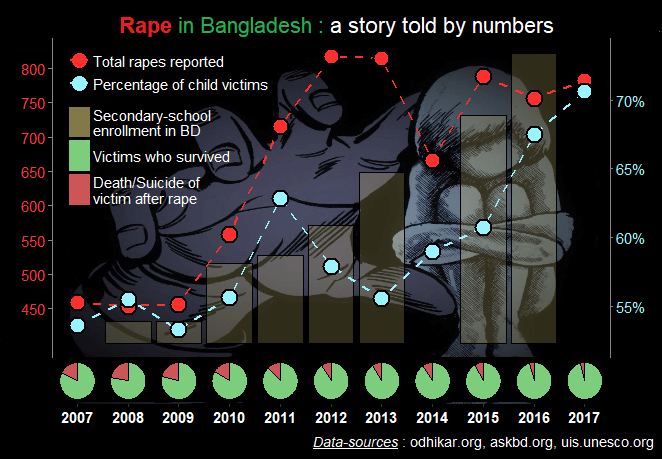
1. According to the sources, the total cases of rapes reported per year (red line) has increased significantly (to about
800 cases/year in 2017) over the last decade.
2. Shockingly, the percentage of victims who were children/below 18 years of age (blue line) has been on the rise ,
reaching close to 70% in 2017!
3. These two things are true even though the education sector of Bangladesh has performed well in enrolling more students
into schools (the brown barchart in the background). So perhaps the thing to learn here is that simply increasing the
quantity of education will not help, the CONTENT of education is also important. What we teach children at school (AND
at home) is vitally important in how he/she affects society. Furthermore, for any prospective/new parents, the blue line
tells us how important it is for children to be able speak to parents about issues of sexual harassment that they might
be facing. Avoiding these issues as "taboos" in our households can only worsen the situation.
4. If there is any good news, it's that the percentage of rape-victims who die/commit suicide as a result of rape has
steadily been decreasing over the last 10 years (red/green piecharts in the bottom). It is perhaps fair to say that the
amazing services for women (such as national helplines, NGOs fighting for victims, and online platforms that give women
a voice, etc) are playing a role in bringing this number down.
5. To keep it simple, we omitted certain important features from this picture, such as report-bias correction (i.e "are
rape cases actually increasing or are they simply being reported more in media?"), and statistical checks for data-reliability
(i.e "is the data even reliable?"). But anyone who is curious is encouraged to reach out, and we can discuss how
we tackled these statistical problems, or even how you would tackle it.